Goat Shit (Journal excerpt)
Translated with DeepL.com
A few eventful days have passed without me taking the time to write a post. But here I am. Right now I’m writing while half-sitting, half-lying down, in the bed of my hotel room near the cathedral in Gescher (a small town north of Essen in the Münsterland region). The occasion: the second part of the bronze casting workshop in collaboration with a bell foundry based in Gescher.
We arrived on Sunday (early yesterday). I woke up at 7:45. That was a problem—our ICE was scheduled to depart from Frankfurt Central Station at 8:15. […] I hadn’t slept well […]. Consequently, when my alarm went off at 7:00 a.m. as expected, I couldn’t convince my muscles to get up. Half an hour later, I was forced to spend 25 euros on an Uber. The amount bothered me, but the fact that Uber was the recipient bothered me even more.
Finally, I was on the train. After changing trains in Cologne, we arrived in Wuppertal. Our destination (on the way through): the Sculpture Park. After a short ride on the suspension railway and a climb past several Tony Cragg sculptures (a fitting preview) and dropping off our luggage with a friendly restaurant owner, we entered the park.
“Sculpture Park” isn’t really a very good name—it’s actually more of a forest that also houses two exhibition halls. And really, it’s all about very large sculptures (though small ones would probably get lost in the forest). If you can tolerate Tony Cragg’s sculptures, the “Forest of Large Sculptures” is definitely worth a visit. In addition to whatever a stressed-out city dweller can get out of a walk in the woods anyway, there are also some good sculptures to see there.
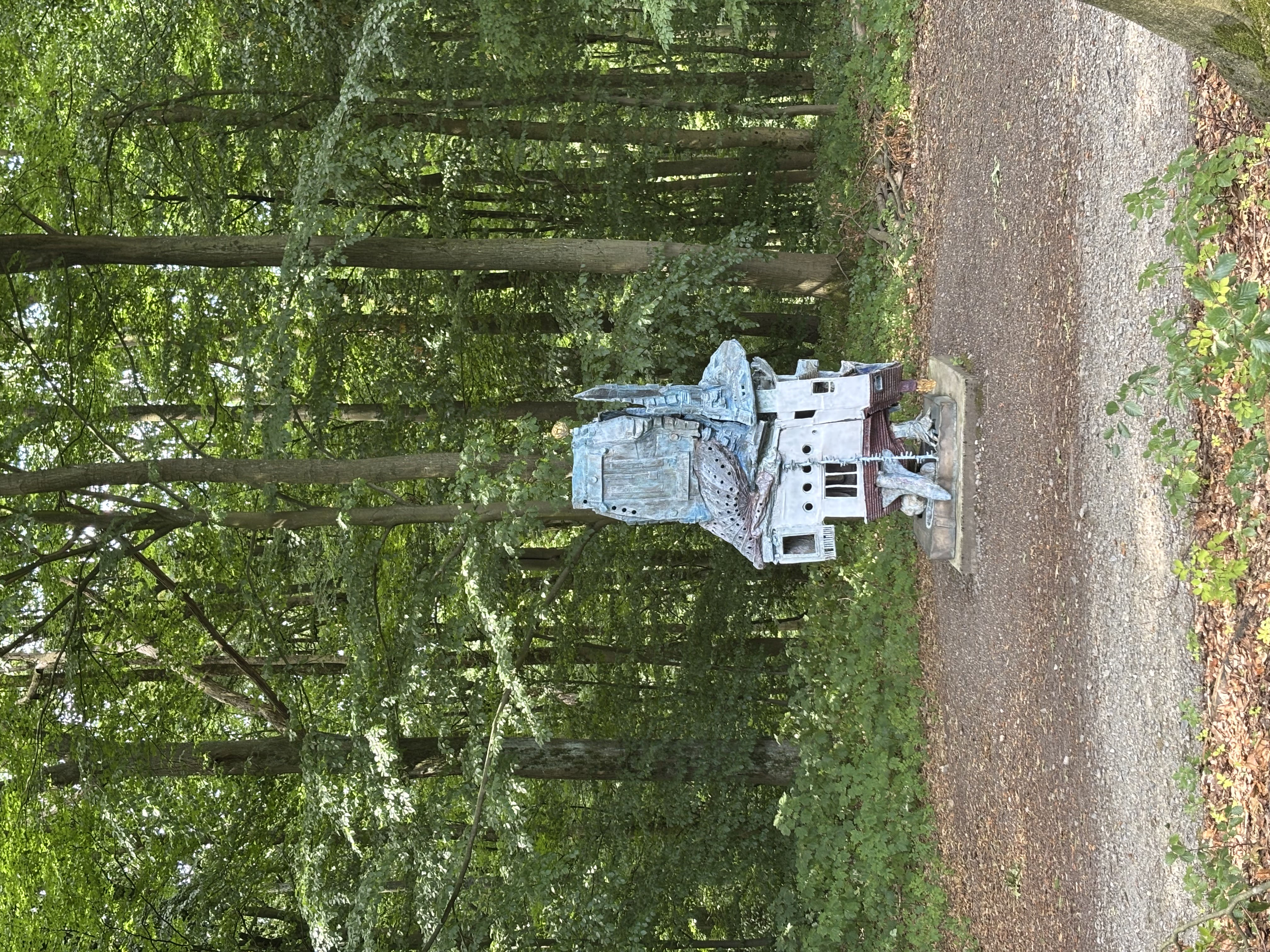
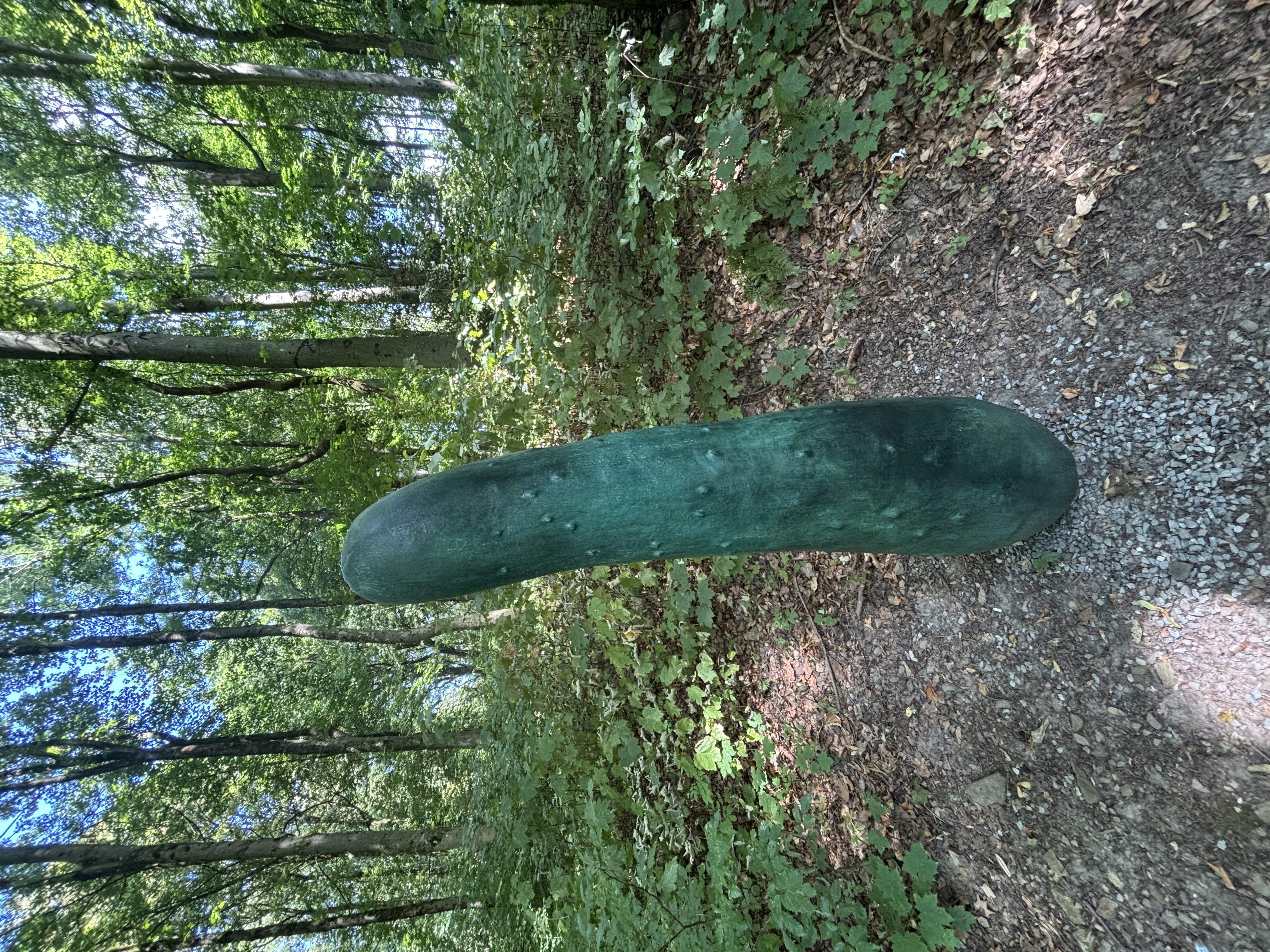
The two works that stuck in my memory: Thomas Virnich’s Helter and Erwin Wurm’s cucumbers. As expected, both align with my preference for figuration and, in light of our upcoming work in Gescher, serve as examples of the deliberate use of patina.
In this forest, one is inevitably confronted with the question of what justifies a large-scale work—or rather, when a large sculpture is a good sculpture. Every other sculpture is by Tony Cragg, who also owns the park (if I owned a park, I’d put my own sculptures there too). His Goat Shit sculptures (not my description—I’ll leave it open as to whether it’s simply a Gen Z term) are hard to miss simply because of their sheer size. By the third one (before even entering the park), I’d had enough of them.
After a lunch break and a three-trains-and-one-bus “Deutschlandticket” odyssey (I shouldn’t have angered the gods), we arrived in Gescher in the evening, so that after a restful, deep sleep, I was able to be at the foundry at 8 a.m. today.
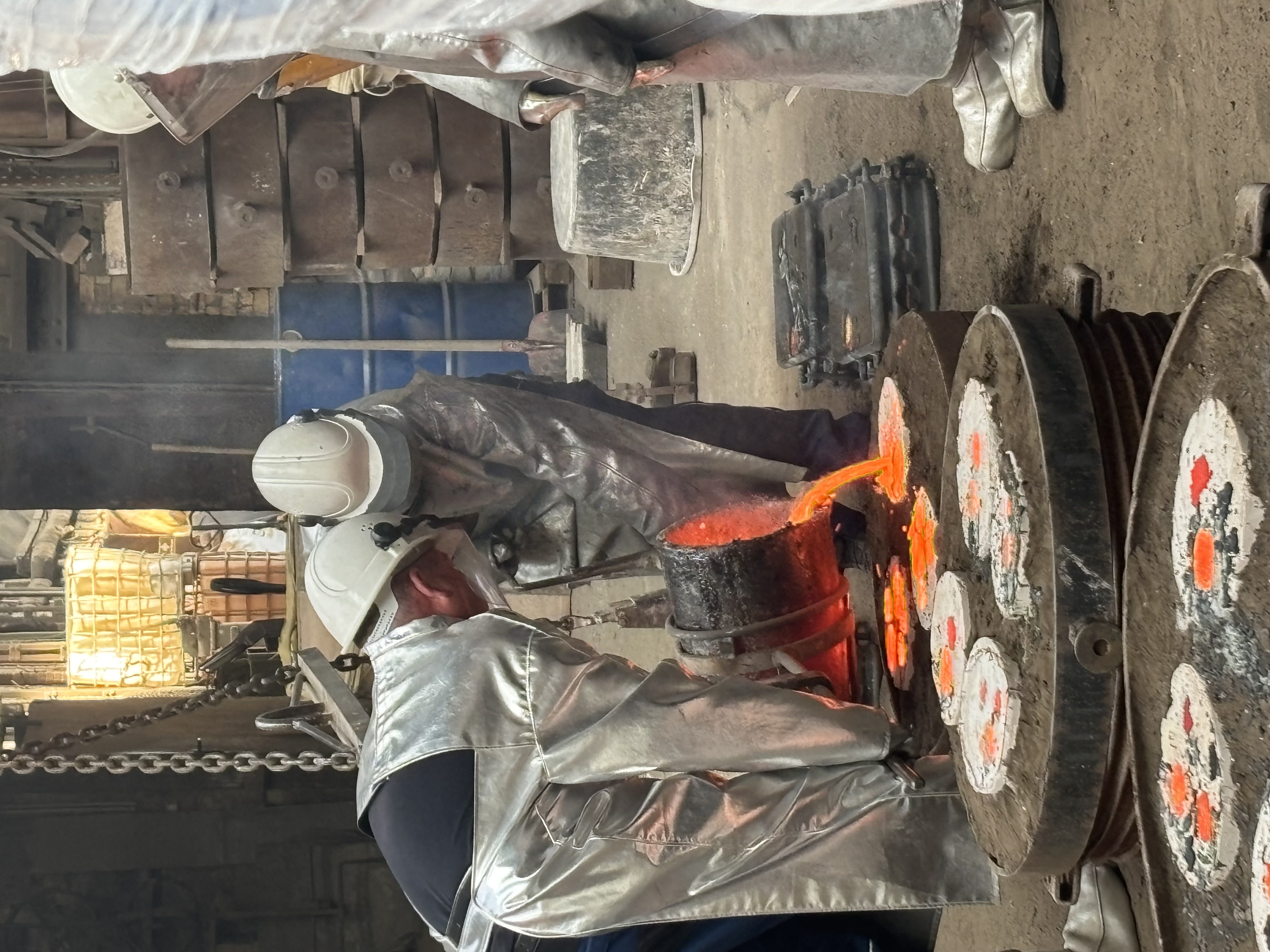
Work there began immediately with pouring the bronze into the molds (carried out by the foundry’s specialists). Our original wax models had already been burned during the production of the plaster molds, so they existed only as the negative of the mold, which was in turn destroyed to produce the bronze. After removing the mold, cleaning the bronze, and finishing it by hand, with an angle grinder, a Dremel, and a sandblaster, I ended the day holding an (almost) finished bronze sculpture in my hands, which will be given a green patina tomorrow. The only thing it has in common with a Tony Cragg work would probably be the material. Would my Pigeons on a Ping-Pong Table (working title) even work as a large-scale piece? I don’t think so at a 1:1 scale. But I could imagine a ping-pong table so large that an adult could walk upright underneath it, complete with correspondingly oversized pigeons and oversized pigeon droppings. Here, too, the choice of oversized proportions would be a conscious decision and not an end in itself. And now enough talking shit about Tony Cragg, despite its suitability as a common thread.
If I could, I’d put a ping-pong table (with pigeons) in the forest. But I think the work thrives on its small size.
Images of pigeons on a ping-pong table can be found here (assuming the work is completed).